
-
How long is the blade of a 500kW wind turbine
According to The United States Department of Energy, most modern land-based wind turbines have blades of over 170 feet (52 meters). This means that their total rotor diameter is longer than a football field. On average, the rotor diameter tends to be around half the height of the. . Wind energy has undergone a massive transformation, represented by the colossal blades propelling turbines into the future of renewable power. During. . By doubling the blade length, the power capacity (amount of power it actually produces versus its potential) increases four-fold without having to add more height to the tower [1]. The DW61 significantly increases kWh output through a larger rotor diameter, which is the result of the latest In addition, the turbine has a number of programmable functions, such as a capability to adjust the power factor and. . In 2023, the average rotor diameter of new wind turbines exceeds 133. Offshore turbine blades are projected to reach lengths of 200 meters (656 feet) for enhanced energy. .
[PDF Version]
-
How many meters is the wind speed of the wind turbine
Home wind turbines typically require an average wind speed of 3 meters per second or more to operate effectively. When the wind speed is too low, the power generation efficiency of the wind turbine will be affected. The wind must blow at a minimum of 9 mph (4 m/s) for a small wind turbine to. . The tips of a modern wind turbine's blades can reach speeds of over 200 mph (322 km/h), although the actual rotational speed, measured in RPM (revolutions per minute), varies significantly depending on the turbine's design, size, and wind conditions. Assuming standard air density (1. 4, and generator and gearbox. .
[PDF Version]
-
How many square meters are usually used for wind turbine rooms in communication base stations
One wind turbine consumes about 20 square meters of land at its base. There are sometimes gravel roads that lead to them from the nearest road, usually 2-3 meters wide and 10-50 meters long, to allow maintenance trucks to get to them. . An August 2009 study for the National Renewable Energy Laboratory examined land-use data for 172 projects, representing about 80% of the installed and targeted wind capacity in the U., and found an average area of 85 acres/MW. According to "Permitting setbacks for wind turbines and the blade. . The direct footprint for a 2-megawatt turbine is typically around 1. 5 acres, while the total land area can range from 40 to 70 acres or more.
[PDF Version]
-
How many volts are the wind turbine blades
The voltage of the electricity produced by the wind turbine is usually classed as “low”, below 1, 000 V, and is often 690 V. . A modern wind turbine is typically equipped with a transformer that increases the generator terminal voltage to a medium voltage around 20-30. For. . In 1919, German physicist Albert Betz showed that for a hypothetical ideal wind-energy extraction machine, the fundamental laws of conservation of mass and energy allowed no more than 16/27 (59. 3%) of the wind's kinetic energy to be captured. A great blade design? That's where you get maximum power with. . The performance, efficiency, and lifespan of a wind turbine largely depend on its blade design and construction. Renewable energy advancements show how blade technology is central to cost reduction and wider adoption.
[PDF Version]
-
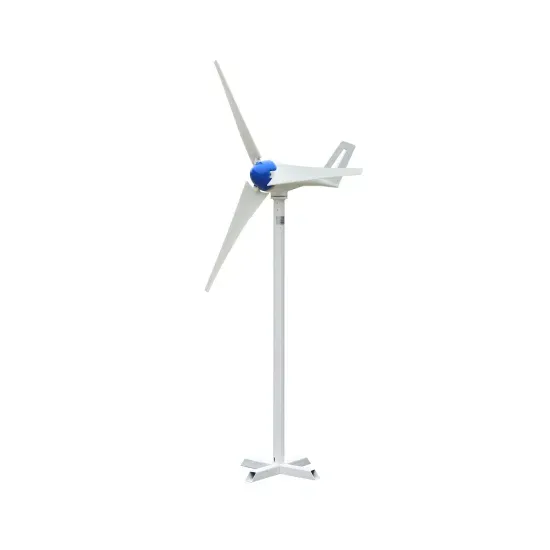
Electric wind turbine blade weight
A wind turbine blade typically weighs between 6, 000 to 22, 000 pounds (3 to 10 tons). Size and material dictate the precise weight of a blade. Vertical-Axis Wind Turbine (VAWT) Blades Vertical-axis wind turbines (VAWTs) have blades that rotate around a vertical axis, as opposed to the. . Wind turbines have very heavy blades - at least if we are talking about industrial wind turbines. Industrial wind turbines have. . Kicking off at a mere 280 grams, wind turbine blade weights skyrocket to 26 tons, but what drives this massive variation in size? You're likely surprised to learn that a single wind turbine blade can weigh anywhere from a mere 280 grams to a staggering 26 tons, depending on its design, material. . These blades, which can stretch over 200 feet in length, are primarily made from composite materials that include fiberglass and carbon fiber.
[PDF Version]
-
6MW wind turbine blade standard
The rotor blade standard — the company's ST-0376 — has been developed by DNV to benefit large, flexible blades for multi-megawatt turbines. 0 MW™ offers a large operational envelope, optimising production in medium to high wind speeds. com is the officially binding version. The documents are available free of charge in PDF format. DNV GL standards contain requirements, principles and acceptance criteria for objects, personnel, organisations and/or. . specifically for the Siemens 6. 0-MW wind turbine, has a swept rotor area of 18,600m2. It therefore maximizes energy yield at offshore locatio ns direct drive technology: the simplest and most straightforward wind turbine design. Other older facilities use turbines from Zond, which was acquired by Enron (the inventor of "green tags"). . Here, Patricia Vázquez our carbon key account manager for wind energy explores how these factors influence the implementation of new wind blade designs, and the standards that guide their manufacture.
[PDF Version]
 MENU